In September 2025, Bunnell's City Commission voted 3-2 to approve the Reserve at Haw Creek, a 2,788-acre development that will eventually add 6,100 homes west and south of the city. City staff project that if every unit gets built, Bunnell's population climbs from roughly 4,000 people today toward something closer to 14,400. Local outlets have called it the largest single development in Flagler County since ITT platted Palm Coast in the 1960s.
None of that shows up when you pull up Bunnell's current median sale price of $289,990 over the twelve months ending in September 2026, up 3% from the year before, with homes averaging 55 days on market against a national average of 58. That number describes a town of about 4,000 people with a handful of new-construction communities. It does not describe a town that has already voted, on the record, to become several times its current size.
The Vote That Changes What "Affordable Bunnell" Means
The Haw Creek approval wasn't quick or quiet. The commission rejected an 8,000-home version of the same project 4-1 in June 2025. Mayor Catherine Robinson revived it two weeks later. By August, the developer, Chad Grimm of Jacksonville-based JM Properties, had trimmed the plan to 6,100 units, and the commission approved a first reading 3-2. The same 3-2 split held for final approval in September, with Mayor Robinson and Commissioners Pete Young and Dean Sechrist in favor, and Vice Mayor John Rogers and Commissioner David Atkinson against.
Rogers called it a "city within a city" with no compatibility with Bunnell's current size or infrastructure. Young saw it differently.
"We need growth... to help the city fix the problems that we have."
That split matters for anyone comparing Bunnell to other Flagler County towns right now. You're not looking at a market where growth is a rumor or a developer's pitch deck. You're looking at a market where the local government has already put its vote on record, reduced the project once, and moved forward anyway.
A Fifteen-to-Fifty-Year Build-Out, Starting From an Empty Field
The approved plan calls for 6,100 residential units, ranging from single-family homes and duplexes to townhouses and apartments, plus a town center, 625,000 square feet of commercial space, 850,000 square feet of industrial space, and roughly 600 units of affordable housing. Estimates for the full build-out run from 15 to more than 50 years.
That timeline is the detail buyers tend to skip past. Nothing about Haw Creek changes the inventory you're looking at this month. The land is rezoned and the development agreement is in place, but the site itself is still farmland and forest west of State Road 11. What's different is that the ceiling on Bunnell's future housing supply is no longer a guess. It's an approved, phased plan on file with the city.
The City Is Already Spending Like the Rooftops Are Coming
Cities don't usually double their wastewater capacity for a population that isn't growing. In July 2026, Congressman Randy Fine visited Bunnell and presented the city with $5.16 million in federal funding for a rehabilitation and expansion of its wastewater treatment plant, taking capacity from 0.6 million gallons per day to 1.2 million gallons per day. The city described the existing facility as a 1972-era plant being brought up to modern standards.
That's a separate signal from the Haw Creek vote itself. A developer's promises about roads and drainage are one thing. A city applying for federal infrastructure money to double its own treatment capacity is a government spending its own credibility on the same growth story. Read together, the vote and the funding tell you Bunnell isn't waiting to see if Haw Creek happens before it prepares. It's already building toward it.
What the Current Median Price Actually Captures
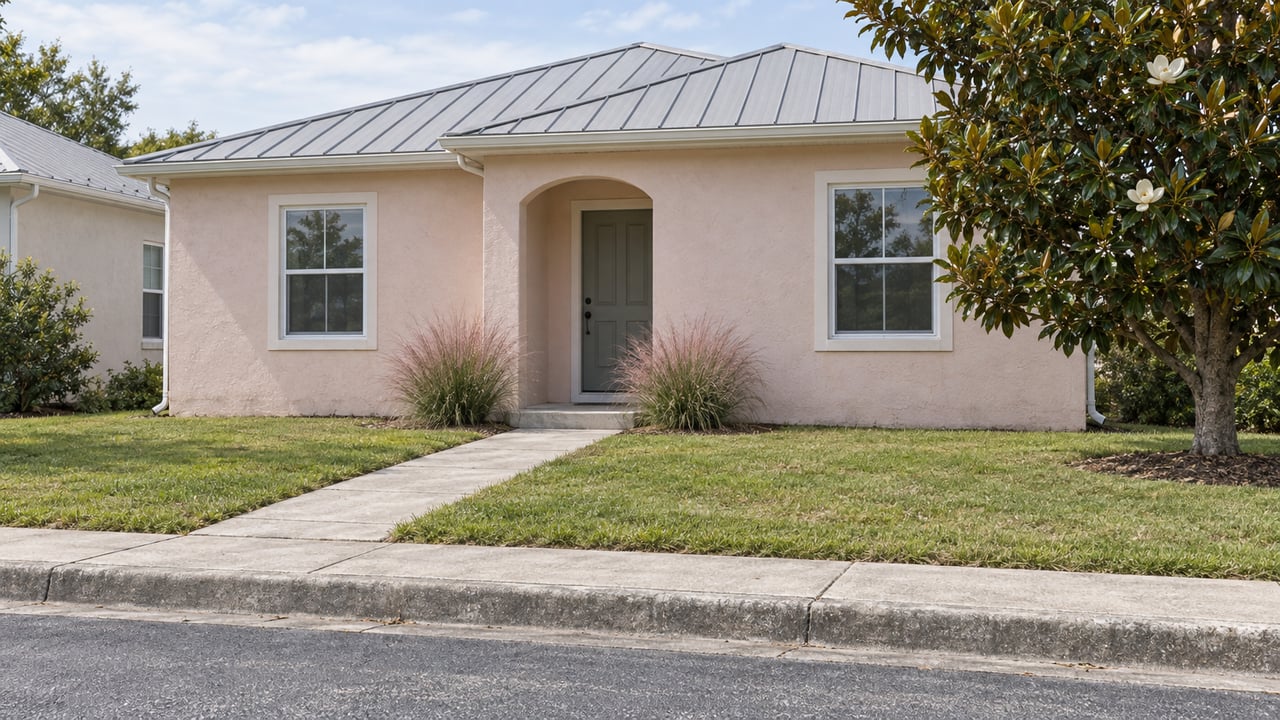
Right now, new construction in Bunnell mostly means Grand Reserve, a DR Horton community with floor plans priced from the mid-$260,000s to the low-$340,000s. That's the supply behind today's $289,990 median. It's a modest, single-builder pipeline in a city that, as of the most recent Census data cited by local reporting, has just over 4,000 residents.
Here's what changes once Haw Creek starts delivering phases, set against what exists today.
| Grand Reserve (existing) | Reserve at Haw Creek (approved, not yet built) | |
|---|---|---|
| Status | Selling now | Approved September 2025, still in state and infrastructure review |
| Scale | Single community, DR Horton | 2,788 acres, up to 6,100 units across multiple builders and types |
| Price range | Roughly $264,990 to $341,990 for current floor plans | Not yet set; includes single-family, townhouse, apartment, and affordable housing components |
| Commercial/industrial | None | 625,000 sq ft commercial, 850,000 sq ft industrial, plus a town center |
| Timeline | Available today | 15 to 50+ years to full build-out |
The gap in that table is the whole point. Today's median price reflects a town before Haw Creek's first phase breaks ground. It says nothing about what happens once thousands of new units, a commercial core, and industrial space start entering the market over the coming decades.
The Friction Worth Asking About Before You Sign
The dissent on the commission wasn't just about scale. Residents near the site, including longtime resident Susie Worley, raised concerns about flooding after seeing what Hurricane Milton did to nearby W Black Point Road, and questioned whether land already prone to standing water could support thousands of additional rooftops. Others pointed to State Road 100, already congested, as a bottleneck the development hasn't yet solved on paper.
Developers told the commission they'd follow state and local regulations and address flooding as part of the project. Rogers and Atkinson wanted the unit count reduced further, to the 5,500 recommended by the city's own Planning, Zoning and Appeals Board, and were outvoted.
None of this means the project won't get built responsibly. It means the infrastructure agreement, drainage plans, and phasing schedule for Haw Creek are public documents worth reading if you're weighing a purchase anywhere near the footprint, which sits in northwest Bunnell near Daytona North, stretching between State Road 100 and State Road 11. The city's own project page tracks each stage of review, from the Future Land Use Map amendment through the developer's agreement and eventual plat approval.
A Few Direct Questions
Has construction actually started on Haw Creek? Not as of this writing. The project has cleared its city-level approvals and moved to state review. Site work and vertical construction follow the developer's agreement and platting process, which the city has not yet completed.
Does this affect homes outside the Haw Creek footprint, like existing Bunnell neighborhoods? The direct footprint is northwest Bunnell, but a development of this scale affects road capacity, school enrollment, and utility demand citywide over time. Buyers anywhere in Bunnell are buying into the same infrastructure timeline, even if their lot sits miles from the rezoned acreage.
Is Grand Reserve connected to Haw Creek? No. Grand Reserve is an existing, separate DR Horton community. Haw Creek is a distinct, larger project from a different developer, still in its early build-out stages.
A median price is a snapshot. Bunnell's snapshot was taken before the town's largest approved development has laid a single foot of pipe. If you're comparing what your money buys in Flagler County right now, that timing is worth understanding before you decide what today's number is actually telling you.
If you want a read on what a specific Bunnell property or lot near the Haw Creek footprint is really worth given where the city's infrastructure spending and approvals stand, David Stanley can walk through the comparison with you directly.